Showing posts with label Diversions. Show all posts

Saturday, May 9, 2009

Onna at lower low tide

Onna is accessible via the 58 or the expressway, exiting at Yaka and crossing the island.
From the 58, there are various places to turn to approach the water and find a spot to park. If you turn at the elementary school, you go down a small road and then go right into a dirt opening, follow that around, get as close to the water as possible, and park. There is a cute beach here. We prefer to turn at Manzamo, take a left before entering the tourist trap, then take a right to get to the straight road parallelling the coast. You can park here and find a trail that heads down to the water. This puts you on the beach near the cave pools. You can also drive further into Manzamo and turn down a tiny unmarked street and follow this downhill. This takes you to a grassy area with a picnic table and the toilet bowl dive site entry.
Onna is a sweet spot to spend a sunny spring day, especially at lowest low tide. Check beforehand at the Tide Toya website: http://www.mobilegeographics.com:81/locations/6543.html
At super low tide, you can walk almost the whole length of this coastline over the exposed shelf. Some live coral is exposed, so you have to be careful to avoid it. There are also plenty of sea urchins, making correct foot placement even more essential. This is not a walk for children. But the tidepools are great along here. There are lots of Japanese people out quite far collecting shellfish or whatever.
This little adventure should be combined with sustenance at a local cafe. Our favourite is Cafe Masaho, which is just south of the Manzamo turnoff on the 58 (west side), and by a restaurant with a pig sign. We have reviewed them elsewhere on this site (open at noon). They do plate lunch for 1000-1200Y - they speak minimal English so just point and shoot. All the food is delicious and healthful. One of the sets is a pasta dish.
Afterwards, head to the Onna Resort public beach, which is just north of the Onna fishing port. There are a couple places to enter from the 58 - one at the fishing port, then you turn right and get to the parking lot, and one a little further north that heads more directly into the parking lot. The beach is behind a sporting field and school. There are public toilets, free picnic areas, vending machines, a snack bar, and a lifeguard. During our visit they were not charging admission or parking. To the south is a great view of the cliffs at Manzamo, and to the north is the ANA Intercontinental resort. They have various boats doing touristy things. There is a swimming area perfect for kiddos. We got some drinks at the local Coco (there is also a Family Mart) and spent a leisurely couple hours at a covered picnic table reading our books. Bliss. The beach does have a loudspeaker system playing J-pop, sol you do have to tune this out, but otherwise it is a great spot.


Friday, May 8, 2009

North of Kadena steps

Location: north of Kadena marina, take one of the small roads off the 58 out to the sea. Park along the seawall in Mizugama.
Golden week has passed, so the carp flags over the river may have been taken down. Regardless, this is a nice walk. The seawall here is nearly deserted, and lined with residences instead of shops. The graffiti on the wall consists of elementary school childrens' murals. You walk to the mouth of the river, and then turn and follow the south bank of the river. The multimedia center marked on the phone book map is an interesting modernist structure. There is a small jetty and on the day we went boat rides up and down the river were 500Y. The river is prettiest on an incoming tide.

Saturday, April 18, 2009

Lily viewing

Location - Zanpa point (take the 6 off the 58) Zanpa point is a lovely place to walk around, especially on a sunny April day. The colours are supersaturated, water views abound, and the cliffs are spectacular. There are lots of lilies and gladiolas planted in this area and they bloom with vigour in April. For those who can't make it to Ie-jima, this is your own personal lily festival, and is remarkable un-touristed. The paths at Zanpa may also be bicycled. The trip can be combined with a lunch at Hanahou for their delicious ahi poke don, spicy Hawaiian-style curry, or pizzas, or to Shimauma curry shokudo for their tandoori chicken and Indian-style curries. Also, the nearby beaches at Zanpa (in front of the Zanpa resort) or Nirai (in front of Nikko Alivia) are inviting and spared from the wind and wave at Zanpa point.

Thursday, April 16, 2009

Himeyuri monument and odokomesu beach

Location: far south of the island; the Himeyuri monument is on the 331 at the Ihara intersection on the north side of the road, west of the Okinawa peace prayer park. Free parking is on the south side of the road. Snack and souvenir shops line both sides of the street. Odokomesu beach (ie Channel Crevice) can be reached by driving towards the water from Odo or Komesu intersections. Off season parking is free, in the summer it appears there is a 300Y charge.
Hours: Himeyuri peace museum 9a-5p admission 300Y, free on memorial day 6/23
This part of the island was the last holdout of Japanese forces during the Battle for Okinawa, so there are multiple sites of remembrance for the fallen. The Himeyuri moument is particularly moving and the museum is a worthwhile overview of the final stages of the battle. Himeyuri refers to girls from two prestigious nearby schools who were pressed by the Japanese military into service as nurse assistants in cave hospitals in the final weeks of the war. They nearly all perished, most after they were told to leave the hospital caves and fend for themselves. There is lots of English text to read, and the translations appropriately peg the blame for the tragedy on the Japanese military's strategy to sacrifice Okinawa and its people in order to slow an advance on the mainland. The surrounding grounds include a cave used as a hospital and are dotted with various memorial statues and attractive landscaping.
From there it is an easy drive to Odokomesu beach (video of the beach: http://www.okinawa-information.com/odocoast-johnman-itoman-beach). The sand is rough and coral-strewn, but the beach is long and nice for a walk. At the east end, there is a path to a memorial at the base of tall cliffs, presumably the site of suicides at the end of the Battle of Okinawa. There are vast dead coral tidepools to explore, and off the shelf apparently decent snorkeling and diving. For those who plan to dive here, be warned that timing your dive with the tides is key in this location. Ideally, the water is low enough the easily find and swim out the channel cut through the dead coral shelf, and when you return it is best to swim back with an incoming tide through the channel.
If making a day of it, the nearby Gushikawa castle ruins are worth a stroll (discussed in another post). We did not visit the Itomansatsuki castle ruins on this visit.

Saturday, January 31, 2009

Flower festival and Okinawan village, Ocean Expo Park

Location: park in P3 at Ocean Expo Park; most of the action is around the staircase which leads down to a viewing area of Ie, with the Aquarium on the right and the traditional Okinawa village Time: Jan 24-Feb 22, 8am - 6pm. On weekends there are street performers and larger crowds The Japanese are great at colour, gardens, and ridiculous cuteness, and this festival has all three. There are also tons of cheesy photo opportunities. For flower lovers, there is also a flower festival at Shuri castle during this same timespan. And the Okinawa International Orchid Show is going on at the lovely Tropical Dream Center (admission 670Y).
When we had enough of the colour, we wandered around the Okinawan village. Not sure how we missed this area on prior visits to Ocean Expo park, but it is quite worthwhile. There are life-size models of lots of different traditional buildings - farmer's homes, a priestess home, granaries, stables, pigpens, and a botanical garden of typical Ryukuan plants.


Friday, January 30, 2009

Sakura viewing on Yaedake

Location: Motobu peninsula off of the 84. The main sakura-viewing road starts just outside of Motobu town and has a dirt parking area and tent stall selling veggies and cotton candy/fairy floss. There are Orion lanterns strung up along the road. There are multiple streets that connect the 84 with this road.
Hours: less traffic on weekdays, but more excitement with the carnival games and food stalls on weekends. Feb 1-2 is a big festival weekend. On our visit yesterday, the sakura was at 70%.
We love the Japanese custom of viewing sakura in the spring. The color is beautiful, the symbolism is heady, and one has to appreciate the foresight in planting all these cherry trees decades ago. Yaedake is a great place to see the sakura. It is an interesting and leisurely drive, with sakura lining almost the entire route along 84, and then the mountain road provides glimpses of the pink-bordered road winding away from you. There are fantastic views of Ie-jima from the top. Be in the lookout for people stopping randomly to capture the perfect photo of themselves with a sprig of sakura, or a wildlife shot of one of the tiny green birds that flit from blossom to blossom. And be aware many of these people are in rental cars, and will take the middle of the road to avoid scratching their car with low-lying sakura branches.
Yaedake was also the site of a major WW2 battle, and if you take some of the sidestreets you might see hide-out caves, steel jungly trails, memorials to the dead, and signs indicating movement of forces. Like so many other areas on Okinawa, you can envision here what a horrible experience it would have been to be a soldier on either side of the conflict, trudging up these unforgiving hills with a 50lb bag under heavy grenade and machine gun attack.
All along the road there are stalls selling the local citrus varieties. Charmingly, many of these are honour-system stands where you put your coins in a box and take your bag of produce. Small bags are approx 250Y, larger ones 500Y. The ground is littered with citrus peels at many of the veiwing spots along the road.
There are a variety of eating options around Yaedake. Okinawahai has posts on Ufuya, a local bakery, and a cafe. http://www.okinawahai.com/my_weblog/2007/03/ufuya-big-house.html, http://www.okinawahai.com/my_weblog/japanese_culture/ (scroll down to middle of loaded page), http://www.okinawahai.com/my_weblog/2009/01/adventure-to-the-british-wine-and-tea-shop.html. We have not visited any of these establishments yet.
During prior visits to Motobu, we have eaten at Kishimoto (the famous soba shop in Motobu town) and a cafe around the corner from there specializing in taco rice. Most recently, we dined at Tejas MC (see next post).

Sunday, December 28, 2008

Chuunaga Spring on Foster


Across the street from the bento box lady and Petit-Voyage on the 81 is a historical placard and some stone work. This is apparently the entrance to an old natural spring complex. From the 81, you can go down the steps and then run into the fence-line for Foster. This site shows the entrance: http://withoutasound.web.fc2.com/ginowan/kiyuna_gusuku_site/index.html. We went looking for the Chuunuga spring, to see if it could be visited from inside the base perimeter. Turns out it is located behind the recycling dump area and a parking area for Marine Corps buses, at the most southern part of Foster (where is abuts the 81). The spring unfortunately is fenced in. There look to be two or three different water spouts and a collection of ponds and waterways. We saw a turtle swimming in one of them. A stone path connects the spring with the entrance point on the 81. As you walk along this hillside, you discover old foundations of buildings and tombs, including a very pretty old turtleback-style tomb. You can almost feel the vibracy of the pre-war Okinawan community that lived, worked, bathed, and died in this area.

Morikawa park

Location: Ginowan, at the southwestern corner of Futenma. Turn left at the first light after Mashiki north intersection, and then make another left at the next decent sized street. The parking lot for the park will be visible from the road. This site has a photo of the entry gate and attractions: http://withoutasound.web.fc2.com/ginowan/morikawa_park/index.html There is no entry fee.
This is a pleasant multi-level park with some nice historical attractions. The natural spring is beautifully maintained/restored, which allows you to visualize it as an important community asset and sacred place. The whole spring is overgrown with ferns and mosses, and there are little fish swimming in the water. Next to the spring is a grassy field with pine trees and a lovely old stone gate. Then you cross back over the spring and head up the stairs to the viewing platform and another grassy field which abuts Futenma. There is a nice view over Chatan and Ginowan and the sea. Returning down the hill, you pass a large stone slide for adventurous children and then an overgrown and locked clay tennis court.

Friday, December 26, 2008

Nakagusuku area

Location: the 146 is a scenic drive past old houses and tombs, lots of bougainvilleas, Nakamura's house, and the ruins of Nakagusuku castle
Castle: hours 8:30a to 5p, admission 300Y
Nakamura house: 9-5:30p, admission 500Y
This is a great area to explore on a sunny winter's day. Nakamura house is attractively landscaped and offers an interesting view into Okinawa's past. About an hour is plenty of time to contemplate the tile, wood, tatami, and ceramics. http://www4.ocn.ne.jp/~knaka/english/.
Down the road, the Nakagusuku castle ruins are quite impressive. You can walk over the curved walls and enjoy views over both coasts. There is a nice open grassy area which is reminiscent of a college lawn, and equally suitable for lying in the sun or having a picnic. There is ongoing renovation at the site. http://www.jcastle.info/castle/profile/109 For more info about other castle sites on Okinawa, including opening hours and admission charges: http://jasonkimball.org/tag/castle/
From the Nakagusuku castle site (past he Kanja gama/Main gate area), you can walk to an abandoned hotel complex that is popular among photographers. It is also a stop on the Haunted Okinawa tours. The complex is really large, with communal baths, tatami and western-style rooms, open halls, a bar, dining rooms, a kitchen, and lots of other rooms with an unclear purpose. Many walls are covered in graffiti, some of it not bad. http://www.okinawahai.com/my_weblog/2008/10/haunted-hotel.html http://www.stumpyjoe.com/okinawaArchive/oct.html From the abandoned hotel you can keep walking along the path passing lots of old tombs; this is the Hanta trail which continues across the hill and down the ridge. This historic trail reportedly courses from Shuri to Nakagusuku. About 800m from the castle there was a sign indicating it was another kilometer to Perry's banner rock. We haven't yet found good information about starting the trail from the Shuri side. Currently there is construction going on at the trail that leads directly from the Hanta trail to Nakagusuku castle. This is bypassed by walking through the abandoned hotel area. For more info about this segment of the Hanta trail: http://joomla.planetfleming.com/index2.php?option=com_content&do_pdf=1&id=3

Tuesday, December 16, 2008

Bicycling on the 58

Location: between Diamond Beach (Seragaki) and Busena is a stretch of the 58 that hugs the coast and is relatively flat. Park across from the Oriental Hills complex in the turnoff, right by Diamond beach and head north from there.
On a sunny winters day, this is a beautiful and leisurely bike ride. There are virtually no pedestrians on the footpath (sidewalk), so it makes a great place to ride and enjoy the scenery. For most of the distance, the path is wide enough for two bicyclists to ride side by side. In a few spots, it cuts through towns and the path narrows and care must be taken in crossing the small streets as cars tend to peek out of them. There is convenience store at Kariyushi beach to toilet and buy refreshments. All along the way there are tracks down to the beach. The beach south of Miyuki is especially nice for a long walk.

Monday, November 17, 2008

Chibuga Spring on Foster

Location: for DOD who have access to Foster, this area is behind the barracks near Gate 3 (currently under construction). It is the forested area south of the gate, between the 130 and the road that goes to the Movie Theater/Tsunami Scuba.
There is a grass clearing visible from the road that heads up the hill to the Movie Theater/Exchange/Tsunami complex. We had to wonder why this area was important enough for the contractors to mow every couple of weeks. Turns out it is a natural spring which was important for the town and farms that existed on this site prior to the war. The following article was written in 1999, prior to the renovation of the area. http://www.japanupdate.com/?id=4287. On page 66 of the PDF file (page 59 of the report) the military discusses the renovation of the area: http://www.fws.gov/Endangered/pdfs/DoD/Tech_Notes.pdf.
The spring now babbles out into a 3-sided stone bath-like structure. The spring site has spiritual significance to Okinawans and was a site of village rituals. The spring then empties into the paddock and meets another creek which comes from higher up the mountain. The water is quite clear and clean. Up the hill towards the barracks, there is a row of trees on what feels like an old village road. On the other hill, there are cave tombs and more foliage. The whole place is quite pretty and tranquil, and would make a nice spot for a picnic. As you walk through the area, you get a sense of how difficult it must be for Okinawans with ancestral claims to these lands to allow them to sit inside fences, inaccessible.

Sunday, August 10, 2008

Keramas boat dive

All the local dive operators offer dive trips to the Keramas. Military operators tend to charge 65-90$ pp depending on number of dives and size of boat. Japanese operators charge more (13-15000Y pp) and often include lunch and may involve a larger, more luxurious boat. For DOD/SOFA, Kadena Marina does trips every Sat and Sun throughout the summer; divers sign up and pay in advance at the office. Trips may also be arranged through Tsunami and private boat captains (usually ex-military men who have married local women and stayed in Okinawa). Both of these organizations do a good job with safety, and have attentive divemasters helping everyone out. The boats are pretty utilitarian, and the bathrooms leave something to be desired, but the captains are experienced and tuned into the needs of the diver. Trips tend to start early in the morning (7:30 or 8a) and return in the afternoon (2:30-4p). No alcohol is allowed. In summer, people dive in rash guards or shorties; on the boat a rain jacket comes in handy if you don't want to wear your wet suit on the way over. In winter, take pants and a fleece for the boat ride and wear the thickest wet suit you have.
Diving the Keramas is a really worthwhile experience, and one worth repeating. The coral is in much better shape than many offshore sites, the visibility is often amazing, and there is a much better chance of seeing turtles, sharks, and other large species. The views are lovely no matter where the boat ends up anchoring. The actual dive sites vary depending on the weather,
currents, and winds. On angry days, there are only a few safe spots, a bay at Zamami behind the main beach is one such site. On calmer days, the boat captain has some flexibility.
Our most recent trips were on the "C Falcon" with Captain Bruce and Kadena divemasters. The divemasters were helpful without being intrusive. The C Falcon is a fast and seaworthy vessel with lots of overhead shade. On one trip, we went to 3 rock bay (others called it goat and shark island), and then did a drift dive in the channel between larger islands. At the former, nurse and white tip sharks hide in the crevices and big groups of reef fish frolic. At the latter, there are beautiful red sea fans, a vast array of coral species, and clusters of large turquoise and purple fish. On another trip, we went to the southern coast of Tokashiki. The coastline here is dramatic and half the fun is getting there. The coral was a bit knocked around, but there were lots of fish, seasnakes, and large sea anemones with clownfish. Then we went again to 3 rock, but dove closer to land and again spotted the sharks, as well as an eel and a group of bat fish.

Sunday, August 3, 2008

Chatan Seaport Festival

In late July - early August, Mihama beach hosts a 2 day festival.
Traffic is disastrous should you choose to park prior to the fireworks and then leave. If you are staying or living within 5 miles, biking or walking is highly recommended. Unless you get there early for the fireworks, plan on standing for the show.
There is the typical Japanese carnival food: hot-dog-on-a-stick, fried octopus, yakisoba, yakitori, potatoes and corn on the cob, various fried foods. There are carnival games. There are lots of Japanese teens in amazing outfits.
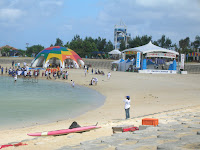
Entertainment depends on the time of day. In the morning on Sunday, there were dragon boat races. Later on, there were other contests. In the afternoon, there is music, then eisa dancers. Finally, the highlight of the festival is the evening fireworks, this year starting at 8:45pm. The show is impressive, especially because spectators are so close to the origination point for the fireworks. There are fireworks that make hearts and smiley faces, and lots of "ooohhh, ahhh" from the crowd.


Saturday, July 26, 2008

Urasoe art museum special exhibit

Location: the Urasoe art museum may be seen from the 330, and is next to Tedako hall. The easiest way to access this area is to turn right on the 38, and turn left at the next main street, where there is a sign pointing to the Library, Museum, and Hall. Park in the lot in front of the Tedako hall entrance. Hours: 9:30-4:30, except on Friday when open until 7p, closed on Mondays, days following National Holidays, and Dec 28-Jan 4 Usual admission is 150Y, but for the special exhibit the price is 1000Ypp. From July 5 until August 17, 2008, the Urasoe art museum has a display of woodblock prints from four masters of the 17-1800s: Hokusai, Sharaku, Hiroshige, and Utamaro. Hokusai is the artist responsible for perhaps the most iconic image of Japan: http://en.wikipedia.org/wiki/Image:The_Great_Wave_off_Kanagawa.jpg
To read more about his life and work: http://www.andreas.com/hokusai.html. While Hokusai focused most on natural settings, Sharaku's work is portraiture of kabuki actors. http://en.wikipedia.org/wiki/Sharaku. Hiroshige's stuff quite beautiful - lots of natural scenes, people in motion, dramatic colours: http://en.wikipedia.org/wiki/Hiroshige. Utamaro is fascinated with the female face and form, and there are lots of lovely prints of courtesan faces. Not surprisingly, the Urasoe museum does not have any of his erotica (http://eviebyrne.blogspot.com/2007/12/utamaros-floating-world.html). The permanent collection is a small but interesting collection of Ryukyu lacquerware. There is a pamphlet with an explanation of the different techniques and how they evolved over time. Similar info is at this site: http://www.pref.okinawa.jp/summit/some/index2.htm. They have a bow-and-arrow set, some really elaborate mother-of-pearl inlaid work, and some modern pieces which we might like to have in our living room. While at the museum, wander the grounds briefly to appreciate the museum building, and climb up the observation tower to look over Urasoe out to sea.

Sunday, May 11, 2008

Diversions - gardening on Okinawa

The Japanese are master gardeners. They are a people sensitive to the seasons, with an exquisite appreciation of colour. Almost every house has a garden, most often planted in a ramshackle collection of pots, but sometimes elegantly landscaped. On Okinawa, many people also have their own vegetable patches, or, if space permits, larger fields with crops ranging from sugarcane to taro to papaya to cauliflower. It is hard not to be inspired by all this, and strike out into your own yard.
Seeds are relatively expensive at Japanese stores, and the variety is not great. So, should you care to plant from seed, best to bring your own supply. Seedlings are available at low cost from home improvement stores like MakeMan and the Ginowan plaza home store, as well as at local family-owned nurseries. All these stores tend to carry seasonal plants, but each has a slightly different selection and pricing, so best to shop around. Soil is a bit expensive at these stores, but if your goal is planting a few pots, it works out fine. The 100Y shops (especially the one in Ginowan plaza) are a great source for gardening accessories including pots and saucers, stakes and wire cages, ties / twins, hand shovels (available in a rainbow of colors), and more. Gaijin trash heaps and PCS sales are also a rich source of plants and pots.
Soil quality is not great in many of the places where gaijin live. The bases were often built up artificially with fill, so the soil is hard-packed clay with very little topsoil. Drainage can be a problem. Thus, in order to plant in the ground the soil must be improved and built up a bit to improve drainage. This requires some sand, decent organic material, and bagged soil / acquired topsoil.
Also, the soil is alkaline (pH 7-9) and seems to be devoid of some key nutrients. There are a couple of ways to address the alkalinity (when one does an internet search on the topic.) We have used coffee ground dug into the soil or scattered around on top. These can be from personal consumption, or from Starbucks. Per a company recycling policy, if you drop off a pail with lid at Starbucks and leave them your contact info, they will fill it with used grounds and call you to pick it up when it's full. Apparently, elemental sulfur works better for this purpose than coffee, but is more difficult to obtain. In addition, one can fertilize with an acidifying product (ammonium based fertilizers will do this - urea, ammonium sulfate/nitrate/phosphate). Regular application of fertilizer is essential should you plan to grown any veggies, and really helps ornamentals.
Weeds are another issue. When planting in the ground, the edges must be protected from grass encroachment with barriers that extend several centimeters into the ground, and on top plastic sheeting or mulch is advisable to prevent wind and soil-borne weeds. The 3 leaf clover is ubiquitous and must be pulled out from its bulb.
Pests are a challenge anywhere, and Okinawa is no different. Local plants seem to do well, but veggies, herbs, and ornamentals like roses suffer from all sorts of things: powdery fungus, viral rust, spider mites, leafminer, caterpillars, aphids, etc. We gave up on organic methods a while back, and are using various fungicidal and insecticidal mists (of course different products on edibles and ornamentals). Beware the plants in the sale counter at the nurseries, these sometimes suffer from early-stage infestations.
Water requirements depend on a variety of factors. Pots in the full summer sun go through huge amounts of water. The ground retains a lot of moisture here, and it rains with regularity even in the summer, so ground plantings need less frequent attention.
The subtropical climate and lack of winter freeze means one can plant at any time in the year, but growth and flowering really picks up as the spring starts (late March). Plants that do really well, with almost no work, are bougainvillea, hibiscus, small crawling succulents (see photo of purple flowers), coleus varieties (http://www.bakersacresgreenhouse.com/Wholesaleliners.htm), ferns, and taro plants. The coleus, geraniums, and the succulent plants are really easy to root - just break off a piece from your friend's plant and stick it in the ground, water regularly, and off it goes. Bougainvilleas can also be propagated from cuttings, although it is reportedly a bit more difficult (http://www.southeasttexasgardening.info/bouginfo.htm). Jasmine, passiflora, ixoras, abutilons, pachystachys lutes (lollipop flower), geraniums, begonias, and lots of other tropicals grow like crazy once established. Roses and gardenias struggle a bit unless soil/pest control is maintained. All the herbs need babying and some attention to soil/pests, but do well once established: thyme, rosemary, mint, sage, basil, cilantro, lemongrass, chives, etc. Tomatoes, peppers, eggplant, and squash all do OK here, if they get enough attention. If you plan to be in Okinawa more than 3 years, plant a few fruiting trees / vines on arrival. Banana, papaya, citrus, and passionfruit are all cultivated on Okinawa. MakeMan also sells kiwi, fig, lychee, and other tropical species.